
What Does Our Sense of Smell Tell Us About Brain Health?
Sep 02, 2026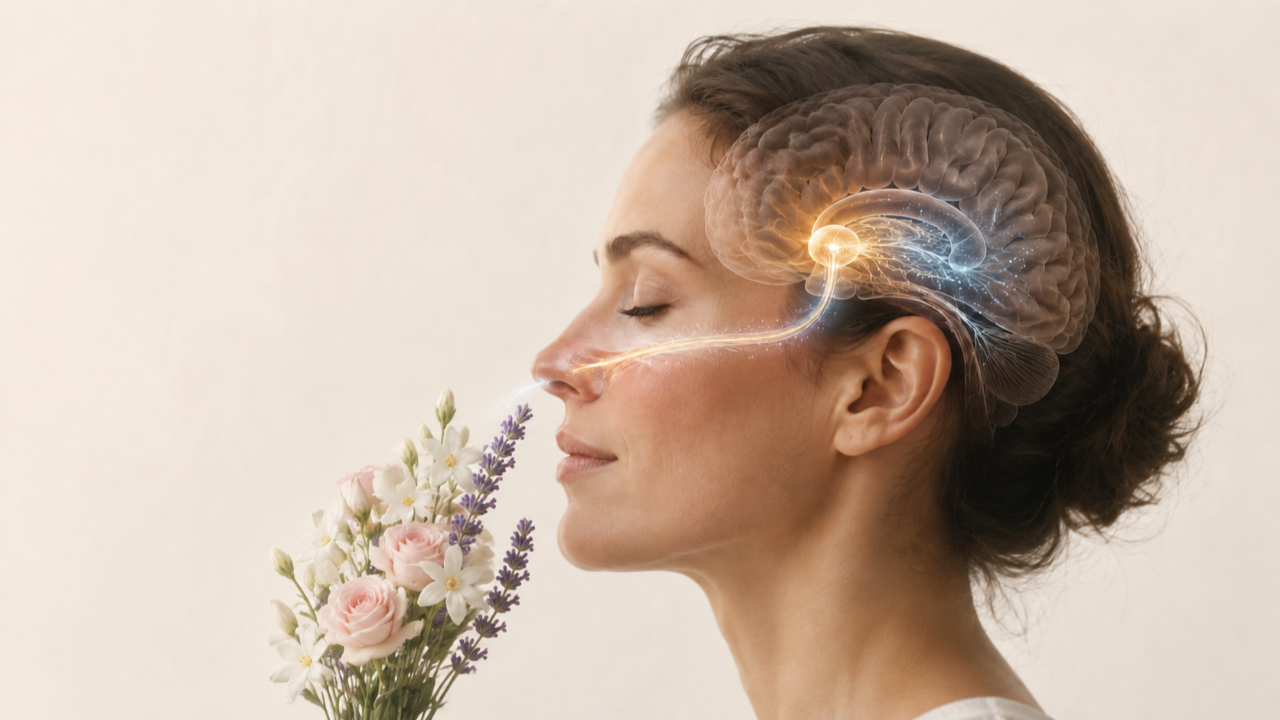
Can having a sharp sense of smell be related to brain health? The short answer is yes.
Smell is unique among our senses: it's the only one whose signals reach the brain's memory and emotion centers without first passing through the thalamus, the brain's main sensory relay station. When you smell something, signals travel from the olfactory receptors in your nose to the olfactory bulb, then directly to regions including the amygdala, entorhinal cortex, and hippocampus. These same areas are among the first affected by the cellular changes associated with Alzheimer's disease. The inflammatory damage and neuron loss that occur in the olfactory system can impair the sense of smell, which is why a diminished sense of smell can be an early sign of neurodegeneration.
Because the olfactory system connects so closely to the hippocampus, smell and memory are neurologically intertwined. A familiar scent like fresh-baked bread, cooking spices or a particular flower can instantly summon a specific time and place from our memory. This is also why a declining ability to identify odors can signal broader neuronal dysfunction.
Notably, odor identification appears to be more strongly associated with cognitive decline than simply detecting whether an odor is present at all. Large longitudinal studies have found that older adults with poor odor identification are more likely to later develop mild cognitive impairment and dementia. Because these changes in smell can emerge long before changes in memory become apparent, scent identification is an important early indicator of cognitive health.
Understanding the Terminology
Several terms describe different types of olfactory change:
- Anosmia: Complete loss of smell. No odor, not even something as strong as smoke or gasoline can be detected.
- Hyposmia: Reduced ability to smell. Strong scents may be perceived only faintly and can be difficult to identify correctly.
- Parosmia: Distorted smell perception. A person may report smelling something burning or foul when no such odor is actually present.
In Alzheimer's-risk research, hyposmia and poor odor identification are especially significant. A person doesn't need to lose their sense of smell entirely for the finding to be clinically meaningful.
How Smell Testing Works
Smell testing is a useful tool for evaluating cognitive health. One common approach is to determine how close a scent source must be to a person's nostril (testing each side individually) with their eyes closed before they can detect its presence, and then to see whether they can correctly identify it. This method can reveal hyposmia and parosmia, as well as anosmia if the person can't detect the odor at all. Common, easily recognizable scents work best: ground coffee, peanut butter, star anise (which smells like black licorice), citrus, or mint are good options.
It's also important to rule out other causes of olfactory dysfunction before attributing a change to neurodegeneration, including:
- Chronic sinusitis or nasal obstruction
- Allergies
- Viral infections, including COVID-19
- Smoking
- Certain medications
- Nasal polyps
- Head injury or trauma to the nose
When these factors have been ruled out, unexplained or progressive olfactory decline is worth evaluating as one piece of a larger risk profile for neurodegenerative conditions such as Alzheimer's disease or Parkinson's disease.
A Potential Timeline
Olfactory changes don't affect everyone, but research points to a general progression:
Normal cognition → declining odor identification → subtle cognitive changes → more noticeable cognitive impairment → dementia
A decline in the sense of smell, particularly difficulty identifying odors, has been associated with an increased risk of cognitive decline and dementia. Because the olfactory system connects so closely with brain regions involved in memory, smell impairment may sometimes serve as an early marker of changes occurring in the brain, sometimes years before noticeable cognitive symptoms appear.
Smell testing is inexpensive, noninvasive, and relatively easy to do at home. I encourage everyone to pay attention to their own sense of smell or to changes a loved one may be experiencing and to test when appropriate, since it can be a valuable screening tool.
Source:
https://pmc.ncbi.nlm.nih.gov/articles/PMC5350628/
https://pmc.ncbi.nlm.nih.gov/articles/PMC10843554/
https://pmc.ncbi.nlm.nih.gov/articles/PMC4710557/
Download the 7 Pillars to a Thriving Mind
A comprehensive ebook guide with journaling prompts by Dr. Kaas to help you protect, preserve and optimize your brain health for a more functional present and future.
We hate SPAM. We will never sell your information, for any reason.